Historical Background of the Certificate
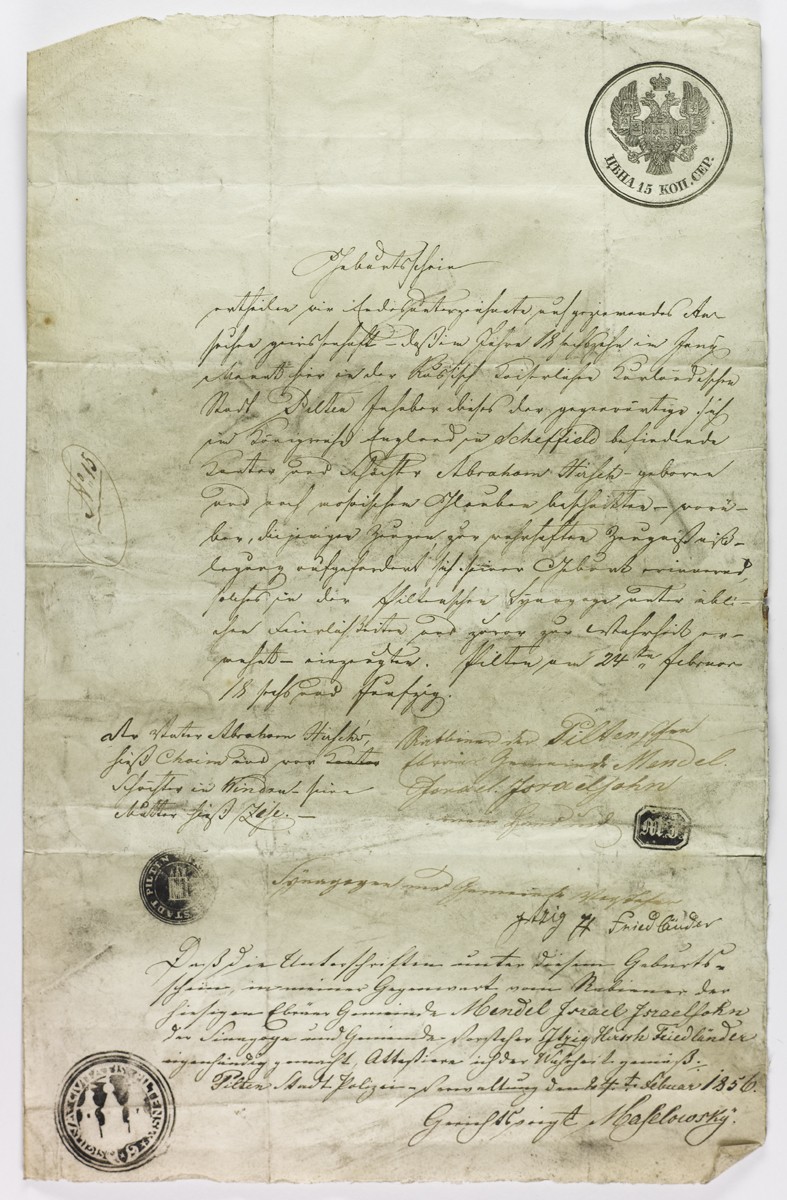
This remarkable historical document is a Jewish birth and circumcision certificate issued in Pilten, in the Courland region of the Russian Empire, on 24 February 1856.
The certificate provides an insight into how Jewish communities documented births and the religious ceremony of Brit Milah (Jewish circumcision) during the 19th century. It records a circumcision performed in 1816, with testimony provided by local Jewish community representatives, including the rabbi and a synagogue elder.
The document is particularly interesting because it also refers to the child's father, Abraham Huschk, who was living in Sheffield, England, when the certificate was issued.
This article provides a detailed explanation of the original German-language certificate, including its English translation, historical background and the significance of its various details.
The Pilten Jewish Birth and Circumcision Certificate
English Translation of the 1856 Circumcision Certificate
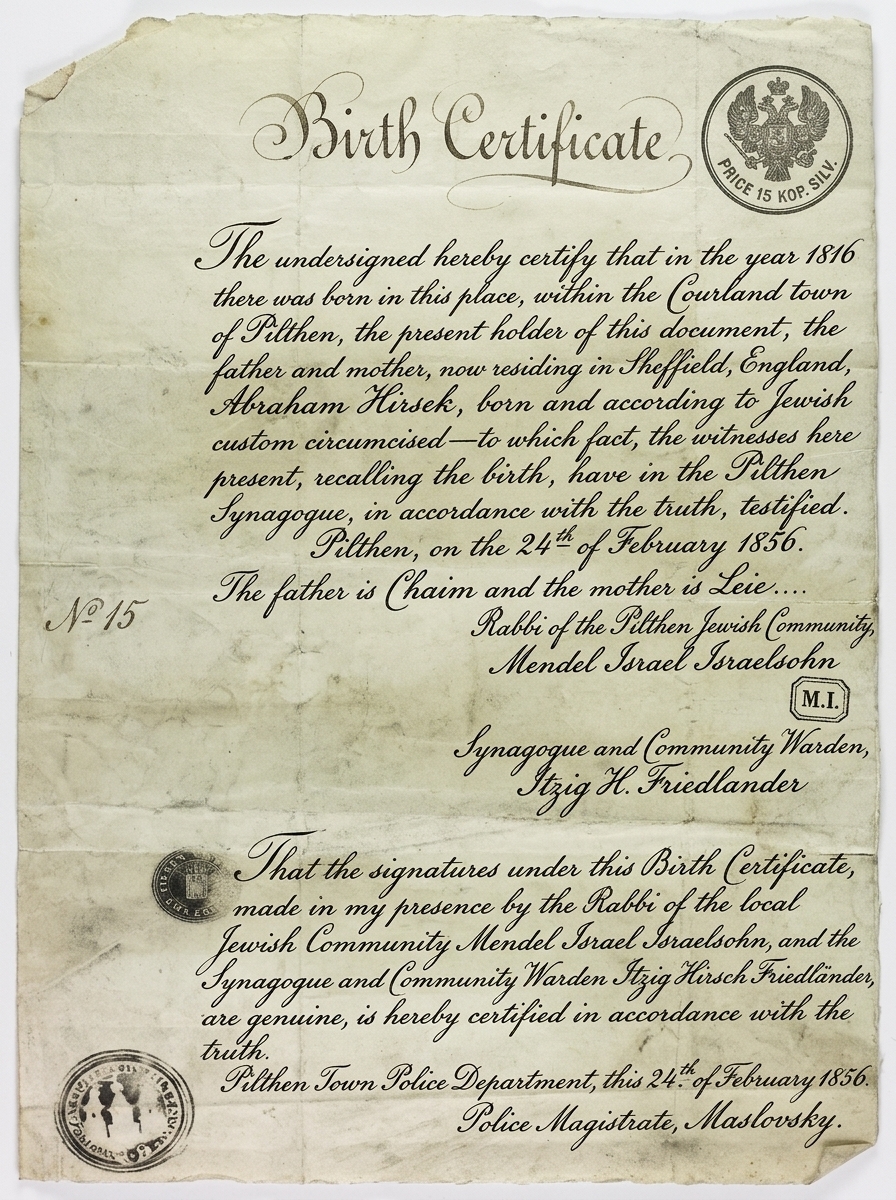
Section-by-Section English Explanation
Birth and Circumcision Recorded in 1816
-
Type of record: An official Birth Certificate (Geburtsschein) issued on February 24, 1856.
-
Certificate Number:
№ 15is written in the left margin.
-
Birth & Circumcision (1816): The document states that in the year 1816, in the Russian Imperial Courland town of Pilten, a child was born and circumcised according to the Mosaic (Jewish) faith.
- How the certificate was made: As the birth and circumcision took place in 1816, approximately 40 years before the certificate was issued, the details were formally confirmed through testimony from members of the local Jewish community.
-
Place of issue: Pilten (modern-day Piltene, Latvia), which in 1856 was a town in the Courland Governorate of the Russian Empire.
-
Father's Name & Location: The child's father is identified as Abraham Huschk, described in the document as a father and scribe. At the time the certificate was issued in 1856, he was living in Sheffield, in the Kingdom of England.
-
Witnesses & Synagogue Ceremony: Witnesses summoned to give truthful testimony solemnly recalled that the rite took place in the Pilten synagogue with the usual prayers and ceremonies.
-
Date & Place of Issue: Dated February 24, 1856 in Pilten.
- Official backing: The paper carries a 15-kopeck Russian imperial tax/duty stamp (
ЦЕНА 15 КОП. СЕР.), municipal seals, and a sign-off from the local town police official confirming the community leaders signed it in front of him.
Family / Parent Note (Bottom Left)
-
This short line below the main paragraph notes details about the family background, referencing Abraham Huschk, a name/association with Chaim and Windau (modern Ventspils, Latvia), and the mother being named Sese.
Jewish Community Signatures
-
Rabbi: Signed by Mendel Israel Israelssohn, Rabbi of the Pilten community (with a small mark/monogram nearby).
-
Community & Synagogue Elder: Signed by Itzig H. Friedländer (Itzig Hirsch Friedländer), Synagogue and Community Elder.
Police Attestation (Bottom)
-
A local official at the Pilten Town Police Administration (Pilten Stadt-Polizei-Verwaltung) certifies on February 24, 1856 that Rabbi Mendel Israel Israelssohn and Elder Itzig Hirsch Friedländer signed the birth certificate in his own presence.
-
It is signed at the bottom by the local bailiff/voigt (surname ending in -owsky, likely ...owsky).
Stamps & Seals Explained
-
Top Right (
ЦЕНА 15 КОП. СЕР.): A Russian Empire state duty stamp worth 15 kopecks silver bearing the double-headed eagle, used on official/legal documents. -
Lower Left & Middle Seals: Official municipal/town seals of Pilten (including
STADT PILTENand a town seal) used to authenticate the official record.
Important Note on Dates & Names
-
English vs. German: While the original certificate is written in German and bears a Russian imperial kopeck stamp, it also provides an interesting connection to Sheffield, England, through its reference to Abraham Huschk, who was living there in 1856
The Historical Significance of the Certificate
This 1856 Jewish birth and circumcision certificate provides a valuable glimpse into the religious and administrative life of a Jewish community in 19th-century Courland.
It demonstrates the importance placed on recording Jewish births and the observance of Brit Milah, as well as the role played by rabbis, synagogue elders and local authorities in formally confirming such events.
The fact that the document was issued approximately 40 years after the birth and circumcision it records makes it particularly interesting. Its reference to Abraham Huschk living in Sheffield, England, also provides a fascinating connection between the Jewish community of Pilten and Jewish migration to Britain.
Beyond its value as a family record, the certificate is a tangible historical reminder of the traditions, religious practices and community structures that helped preserve Jewish identity across generations.
.